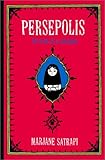
Title: Persepolis
Author: Marjane Satrapi
Publisher: Pantheon
Genre: Graphic Novel
Number of Pages: 153 pages
Discovery of Book:
Reading Level: Lexile Level- 380
Awards: Booklist, Kliatt starred, Library Journal starred, New York Times, Publishers Weekly starred, School Library Journal, Voices of Youth Advocates, Wilson's Senior High School
Summary: A young girl, Marji, from Tehran, Iraq, tells of her life and country's struggles during the 1980's as Iran entered the Islamic Revloution. Through the use of mininamlist comic book pictures, Marji leads the reader through government overthrow, totalitarianism, strict clothing restrictions, and the war between Iran and Iraq. Eventually the contry's politics become so tumultuous Marji is sent by her parents to live in Europe to escape the violence that blanketed her precious home country.
Personal Connection: The Islamic Revolution is a time period that seems to be left out of high school history. Persepolis is a humourous take on life, yet looks seriously at government, belief system, and oppression. Marji does an excellent job of showing the destruction of life that occured in Iran during the '80's. She describes her maid telling her family about a key that her poverty stricken son was given at school. The students were told that the key was their entrance ticket to heaven if they went to war for their country. It shocks me that during such a modern time, children were being sent to war. I know that it has happened throughout history and is still currently a practice in many countries around the world; but how could anyone strip the childhood inocence of a helpless young boy or girl? This question certainly lingered in my mind as I finished reading about the various other obstacles Marji and her people faced during the Islamic Revolution.
Evaluation/Analysis: At a lexile level of 380, Persepolis could be easily read by many elementary school students. However, because of its dark content and mature topics, this story would be best suited for mature middle school students or even high schoolers. The use of a comic book structure makes it appealing to your adiment non-readers. They learn a plethora of information by reading the book, yet feel a sense of accomplishment when they realized they read 150 pages in a short period of time.
In the classroom, Persepolis would be best used to allow students to gain an understanding about Iran, it's culture, and the events that occured during and after the Islamic Revolution. Students would be able to take the various attrocities that occured, record them in their journal, and use their newly learned information to help them determine if during the 1980's, Iran suffered a holocaust.
Author: Marjane Satrapi
Publisher: Pantheon
Genre: Graphic Novel
Number of Pages: 153 pages
Discovery of Book:
Reading Level: Lexile Level- 380
Awards: Booklist, Kliatt starred, Library Journal starred, New York Times, Publishers Weekly starred, School Library Journal, Voices of Youth Advocates, Wilson's Senior High School
Summary: A young girl, Marji, from Tehran, Iraq, tells of her life and country's struggles during the 1980's as Iran entered the Islamic Revloution. Through the use of mininamlist comic book pictures, Marji leads the reader through government overthrow, totalitarianism, strict clothing restrictions, and the war between Iran and Iraq. Eventually the contry's politics become so tumultuous Marji is sent by her parents to live in Europe to escape the violence that blanketed her precious home country.
Personal Connection: The Islamic Revolution is a time period that seems to be left out of high school history. Persepolis is a humourous take on life, yet looks seriously at government, belief system, and oppression. Marji does an excellent job of showing the destruction of life that occured in Iran during the '80's. She describes her maid telling her family about a key that her poverty stricken son was given at school. The students were told that the key was their entrance ticket to heaven if they went to war for their country. It shocks me that during such a modern time, children were being sent to war. I know that it has happened throughout history and is still currently a practice in many countries around the world; but how could anyone strip the childhood inocence of a helpless young boy or girl? This question certainly lingered in my mind as I finished reading about the various other obstacles Marji and her people faced during the Islamic Revolution.
Evaluation/Analysis: At a lexile level of 380, Persepolis could be easily read by many elementary school students. However, because of its dark content and mature topics, this story would be best suited for mature middle school students or even high schoolers. The use of a comic book structure makes it appealing to your adiment non-readers. They learn a plethora of information by reading the book, yet feel a sense of accomplishment when they realized they read 150 pages in a short period of time.
In the classroom, Persepolis would be best used to allow students to gain an understanding about Iran, it's culture, and the events that occured during and after the Islamic Revolution. Students would be able to take the various attrocities that occured, record them in their journal, and use their newly learned information to help them determine if during the 1980's, Iran suffered a holocaust.

No comments:
Post a Comment